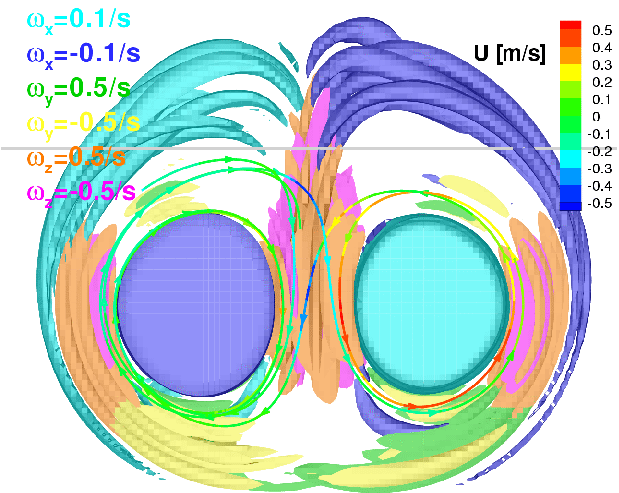
All 3 vorticity components of a wake vortex in a weakly stably stratified
atmosphere.
Baroclinically produced vorticity induces verticalvorticity which is
intensified by vortex stretching.
Subsequently, vortex
tilting transfers verticalvorticity into lateral vorticity and vice versa.
Streamline indicates
efficient transport between the primary vortices -
this effect is
prerequisite for rapid decay mechanisms.
Paper 1:
Two-Dimensional Wake Vortex Physics in the Stably Stratified Atmosphere.
F. Holzäpfel, T. Gerz
Aerospace Science and Technology 5 (1999) 261-270.
Abstract
The effects of stable stratification on aircraft wake
vortices are investigated
by means of high-resolution two-dimensional
simulations. The simulations
elucidate that the vortices first
decelerate and then accelerate their descent,
where they largely conserve
their circulation. However, for very stable
stratification the tip
vortices may rise again to the flight path. The
underlying physical
mechanisms are revealed by means of a point vortex method
and are examined
complementarily by balancing the impulse of the wake vortices.
It is shown
that the prominant effects, deceleration, detrainment and
acceleration, are
caused by the kinematic interaction of the vorticity generated
by
baroclinity and the primary vorticity. Furthermore, it is found that the
impulse of the whole system, including the detrained secondary vorticity,
is oscillating with the Brunt-Väisälä frequency which implies that the
wingtip vortices themselves do not. Finally, a local shear--number is
proposed
which takes into account the interaction of primary and secondary
vorticity and
can describe the instantaneous tendency of wake vortices to
accelerate or to
decelerate.
Paper 2:
The turbulent decay of trailing vortex pairs
in stably stratified environments
Frank Holzäpfel, Thomas Gerz, Robert Baumann
Aerospace Science and
Technology 5 (2001) 95-108
Abstract
The decay of trailing vortex pairs in thermally stably
stratified environments is
investigated by means of large eddy
simulations. Results of in-situ measurements
in the wakes of different
aircraft are used to find appropriate intitializations for the
simulation of
wake turbulence in the quiescent atmosphere. Furthermore, cases
with
weak atmospheric turbulence are investigated. It is shown that the early
development of the vortices is not affected by turbulence and develops
almost
identically as in 2D simulations of wake vortices in stably
stratified environments.
In a quiescent atmosphere the subsequent vortex
decay is controlled
by the interaction of short-wave disturbances, owing to
the aircraft
induced turbulence, and baroclinic vorticity, owing to stable
stratification.
As a consequence, vertical vorticity streaks between the
vortices are induced
which are substantially intensified by vortex
stretching and finally lead to
rapid turbulent wake--vortex decay.
When in addition also atmospheric
turbulence is present, the long-wave
instability is dominantly promoted. For
very strong stratification
($Fr<1$) it is observed that wake vortices may
rebound but lose most of
their strength before reaching the flight level.
Finally, the simulation
results are compared to the predictive capabilities of
Greene's approximate
model.
Download
(pdf, 2.7 MB)
(warning: the letters are of good quality only when the
paper is printed)